JL
Curated and written by
Joseph Lock
AFS City Guide Content Creator
Studying at University College London
8 min read·Last updated: 2 June 2026
"A historic yet cosmopolitan capital, famous royal heritage (Buckingham Palace), iconic landmarks (Big Ben, Tower Bridge, London Eye), and world-class museums like the British Museum."
Known for being the top UK city for job opportunities, London is a global hub for all careers – especially for students looking to specialise in finance, technology, and media. The city offers unrivalled access to internships, placements, and top employers which provide higher graduate starting salaries than other cities. The area also allows you to branch out and work with firms that are famous elsewhere in the world e.g. big American companies that have London city branches. Opportunities aren’t just for graduates though; every day students can attend a workshop of some kind to network and build contacts early.
London has universities dotted all over the city allowing you to attend an institution no matter where you live in the district. The city is home to some of the global top-tier institutions, notably including four of the world’s top 40 universities. People travel from all over to specialise in certain areas of study hence why the capital of the UK is a centre for academic excellence in fields like business, law, and medicine. Famous people including Mahatma Gandhi, Christopher Nolan and David Attenborough have studied at various universities in London.
With trains, Eurostars, airports, buses, and the Underground – whatever form of transport that you fancy, London has it. The larger number of city connections allows students to use public transport system easily and they can navigate anywhere within the city at a pretty cheap price. Not only is transport easily accessible within the city but the systems also allow for travel to the rest of the UK and Europe, allowing students from outside of London (including internationals) to travel home easier.
London is full of history and culture with over 1,000 museums and galleries, as well as 350 live music venues – there is always something to do. For art fans, the Royal Academy of Arts and the Tate Britian are a must see. The Columbia Road flower market is a stunning sight, a bright display of colour to brighten your day! For football fans, the Oof Gallery in the Tottenham Hotspur stadium is a contemporary art gallery focused on football.
Wondering how much it costs to live in London as a student? We’ve broken down typical monthly expenses and compared them to the national average, so you can plan your budget with confidence.
| Expense | London average | National average | Difference |
|---|---|---|---|
| Rent (monthly) | £1690 | £891.63 | £798.3790% more |
| Utilities (monthly) | £125 | £112.25 | £12.7511% more |
| Bus pass (monthly) | £67 | £61.13 | £5.8710% more |
| Groceries | £17.75 | £15.40 | £2.3515% more |
| Gym pass (monthly) | £56.23 | £34.59 | £21.6463% more |
| Takeaway coffee | £3.99 | £3.54 | £0.4513% more |
“London has the best transportation system!”

Arden University is a private establishment that offers online and blended courses to students across the world. Find out more here.
Read guide →
BPP University is a private for-profit university, it was not until 2013 that it became the BPP university, as it is known today.
Read guide →
Imperial College London is the only university in the UK to focus entirely on engineering, science, medicine and business.
Read guide →
Founded in 1829, King’s College London is a Russell Group university with five campuses across London, combining an international academic reputation with student life in the capital.
Read guide →
London Metropolitan University has roots going back to 1848, making it one of the oldest institutions in London.
Read guide →Founded in 1895, the London School of Economics and Political Science is a specialist social sciences university in central London, combining an international academic reputation with student life in the capital.
Read guide →
London Southbank University is based in Elephant and Castle, near the South Bank of the River Thames.
Read guide →Based at Ealing Studios in West London, MetFilm School offers practical courses in film, television and digital media, giving students the chance to develop their creative skills within a working studio environment.
Read guide →
With a committed green Students’ Union and a high employment rate, Ravensbourne University allows students to develop key skills for their future.
Read guide →
With a diverse range of societies, Regent’s University London allows students to expand their knowledge and also their skills.
Read guide →
With an inclusive student union and several funding options, the University of Roehampton ensures that students will have a great chance at an education and a bright future.
Read guide →SOAS University of London combines specialist knowledge of Asia, Africa and the Middle East with an international student community and a central London campus in Bloomsbury.
Read guide →
St Mary’s Universities caters to student needs, providing each one with individual opportunity and support to ensure the best future possibilities.
Read guide →
Founded in 1826, University College London (UCL) combines a global reputation for teaching and research with a diverse student community and campuses in Bloomsbury and east London.
Read guide →
With a high employability rate and a long history, the University of East London strives to provide the best opportunities for its students.
Read guide →
The University of Greenwich is situated in London and Kent, with three campuses which can be reached by public transport. Greenwich Campus is the largest and is set in a World Heritage Site on the banks on the River Thames.
Read guide →
The University of London is one of the largest, most diverse universities in the UK with over 12,000 students in London, and a further 50,000 studying across 190 countries for a University of London degree.
Read guide →
Ranked second in the world for Art and Design, the University of Arts London gives its students brilliant opportunities to develop and showcase their skills.
Read guide →
The University of West London is based over three campuses, two of which are in London and one in Reading.
Read guide →
The University of Westminster is over 180 years old and attracts over 20,000 students every year from 169 different countries.
Read guide →London is the city with the most job prospects in the UK but it is still highly competitive for graduate schemes. There are a wide variety of opportunities for careers in financial and professional services (banking, law and accounting etc.), as well as creative industries, life sciences and tourism.
Here are some key facts about employment prospects in London:
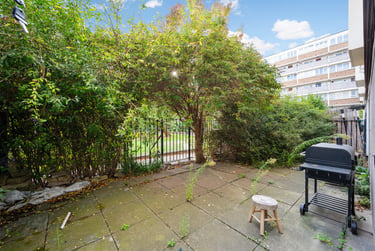
96 properties
Avg. £352/week
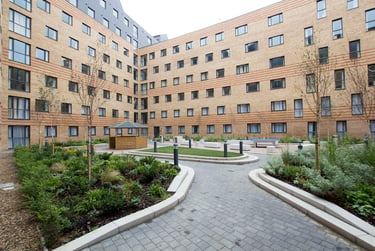
17 properties
Avg. £228/week
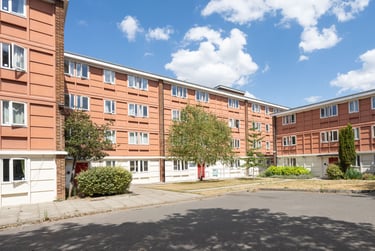
151 properties
Avg. £327/week
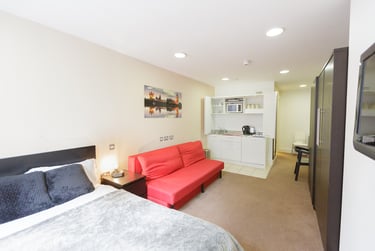
279 properties
Avg. £405/week
AFS City Guide Content Creator
Studying at University College London
Joseph is a fourth year MSci Physics student at UCL, where he is researching energy management in the built environment for his master's project. He is also a City Guide Content Creator at AFS, drawing on his own student experience to create the London city guide.